 Men’s Moto Leather Jackets
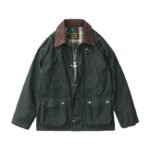 Faux Moto Leather Jacket
 Vintage Moto Leather Jacket
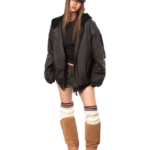 Women’s Moto Leather Jackets
 Faux Moto Leather Jacket
 Vintage Moto Leather Jacket Women
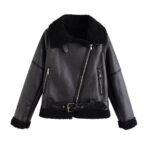 Cropped Moto Leather Jacket Women
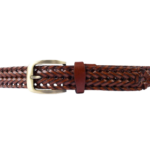 Men’s Leather Belts
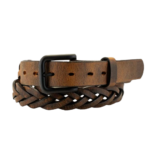 Full-Grain Leather Belt – Men
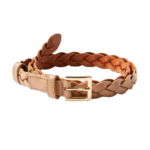 Braided Leather Belt – Men
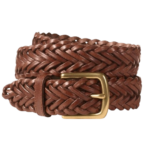 Leather Dress Belt – Men
 Leather Wallets
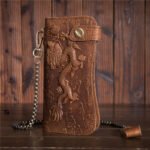 Full- Grain Leather Wallets
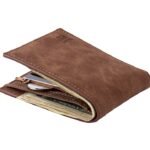 Tri-Fold Leather Wallets
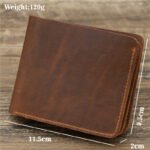 Saddleback Leather Wallets
 Moto Gloves
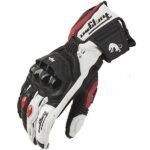 Moto Heated Gloves
The Real Difference Between a 1950s and a 1970s Motorcycle Jacket

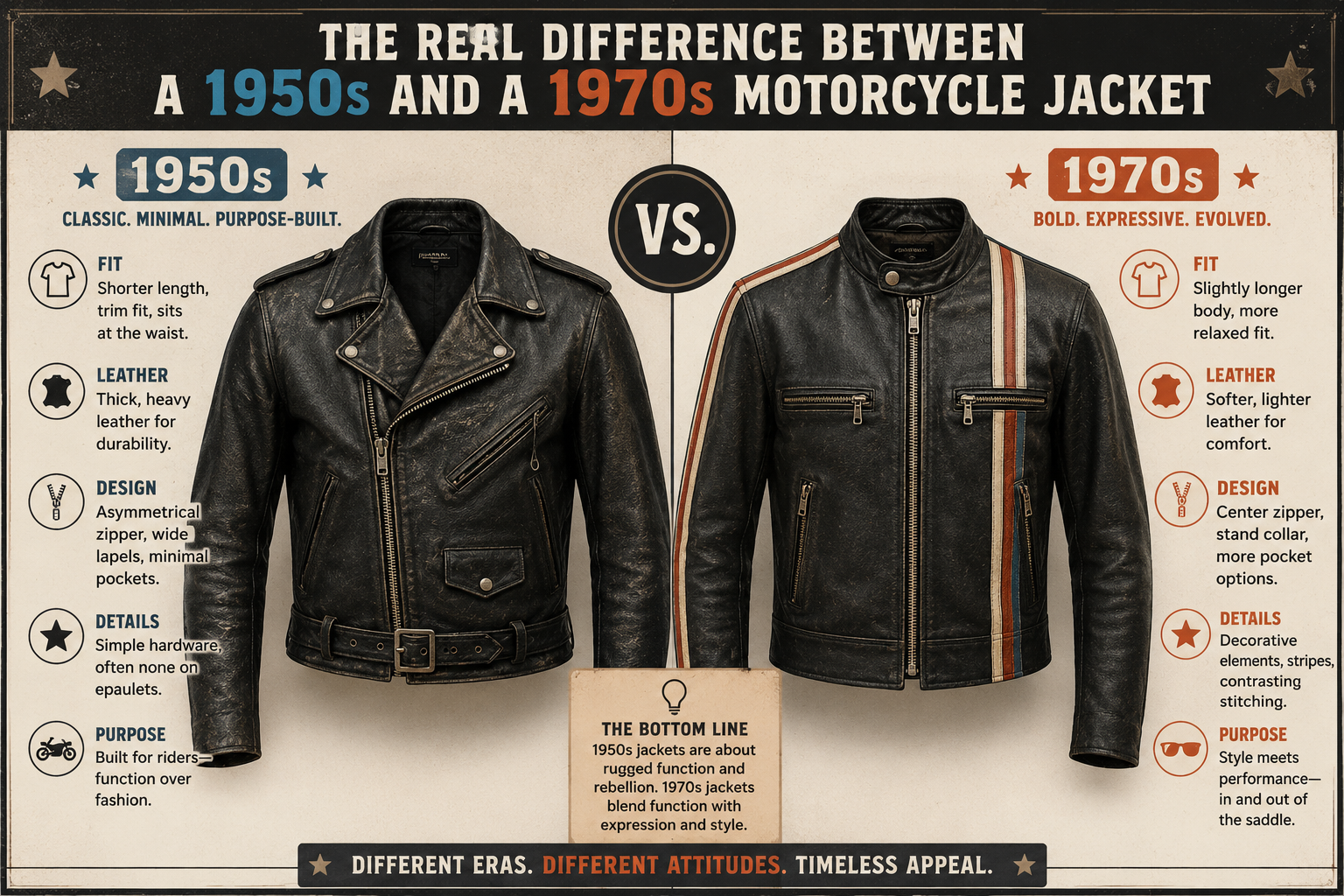
Pull up two vintage motorcycle jackets side by side — one from 1955, one from 1972 — and most people couldn’t tell you which is which. They’d see leather, zippers, an asymmetric front, and assume they’re basically the same thing from different years. That assumption costs buyers real money and leads to collection decisions they later regret.
The truth is that the 50s vs 70s biker jacket gap is one of the most significant in the entire vintage moto jacket era differences landscape. These are not minor iterations on a common design. They reflect fundamentally different manufacturing philosophies, material standards, and cultural contexts. Understanding the distinction is the foundation of buying intelligently in the vintage market.
—
The 1950s: When the Jacket Was Still Functional Gear
To understand a 1950s motorcycle leather jacket, you have to understand what it was built to do. In the postwar era, the people wearing moto jackets were overwhelmingly people who actually rode motorcycles. The jacket was protective equipment first and a style statement second — if it was considered a style statement at all.
This functional priority shaped everything about how the jackets were constructed.
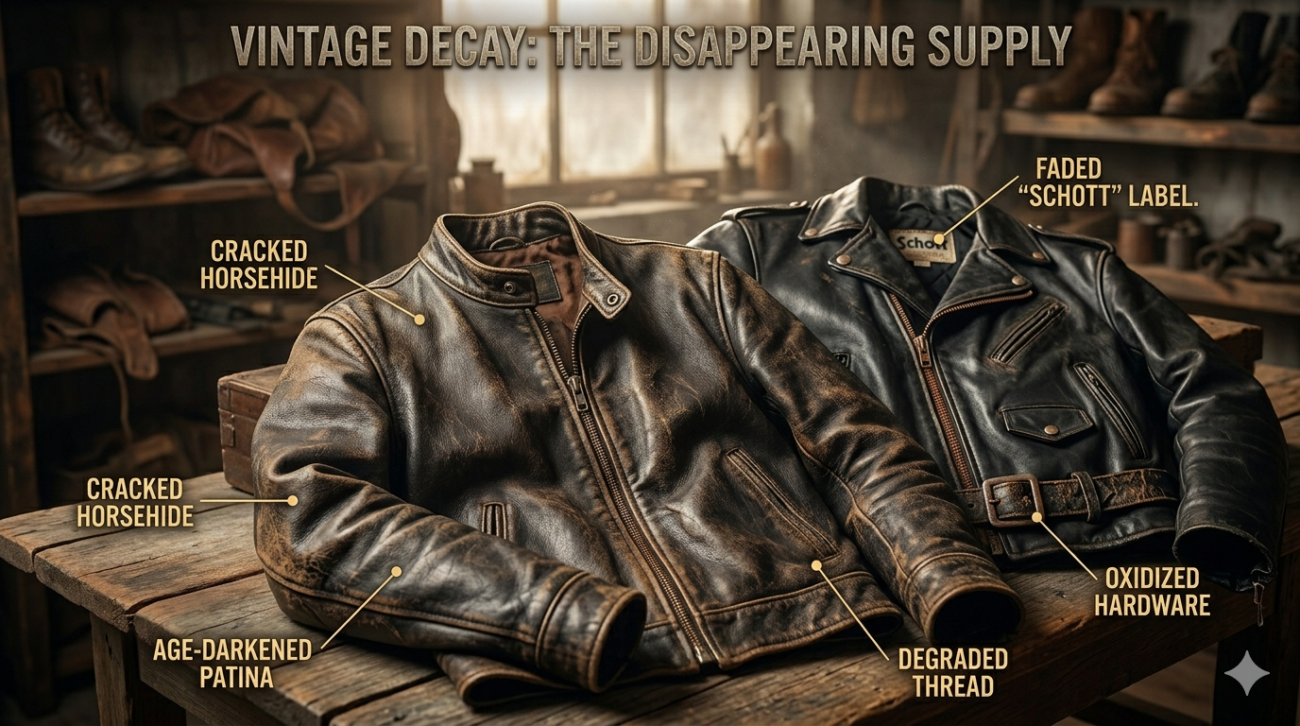
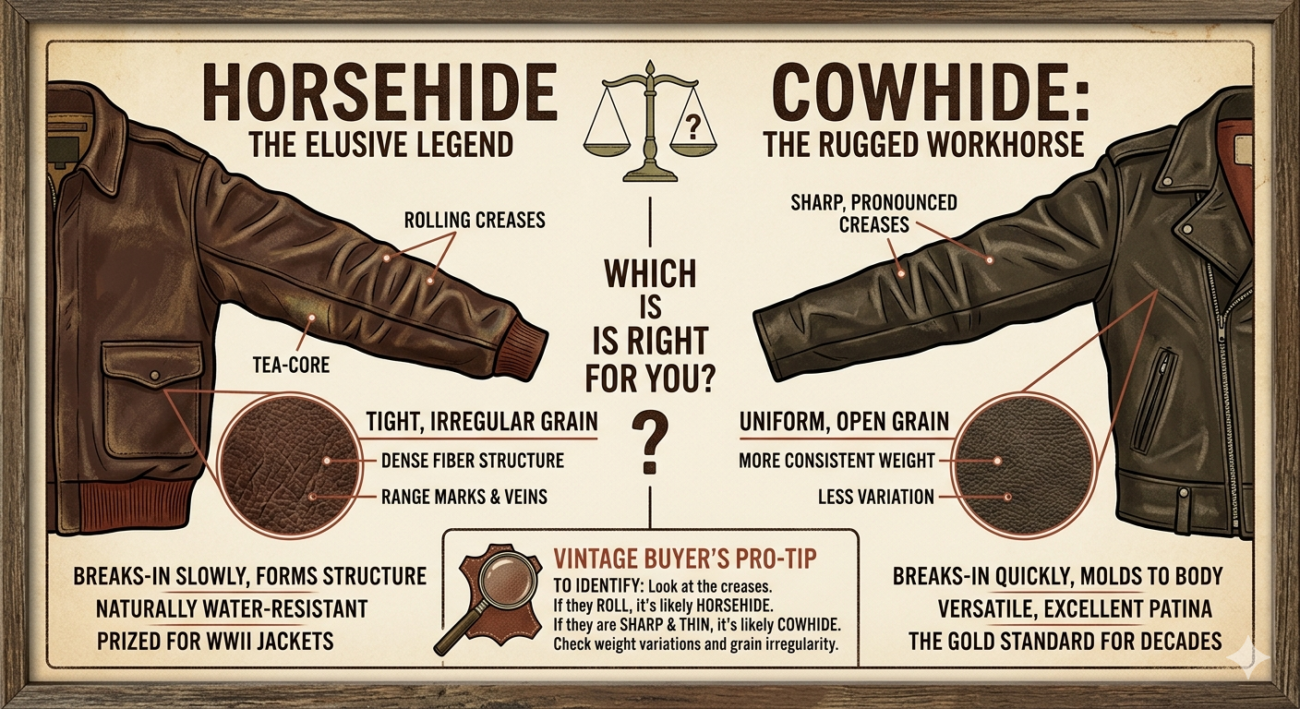
Leather selection was serious. Horsehide was the dominant choice for premium 1950s moto jackets, and the quality of that horsehide was remarkable by any modern standard. Dense, tight-grained, with a natural stiffness that broke in over years of wear rather than months. When you find a 1950s horsehide piece in good condition today, you’re handling leather that was selected with genuine performance expectations — impact resistance, wind resistance, durability across years of hard use.
Cowhide pieces from the same era also tend to be heavier and more substantial than what came later. Tanneries hadn’t yet optimized for lightweight or soft-at-purchase leather. The hides used were thicker, and the tanning processes produced leather with real density.
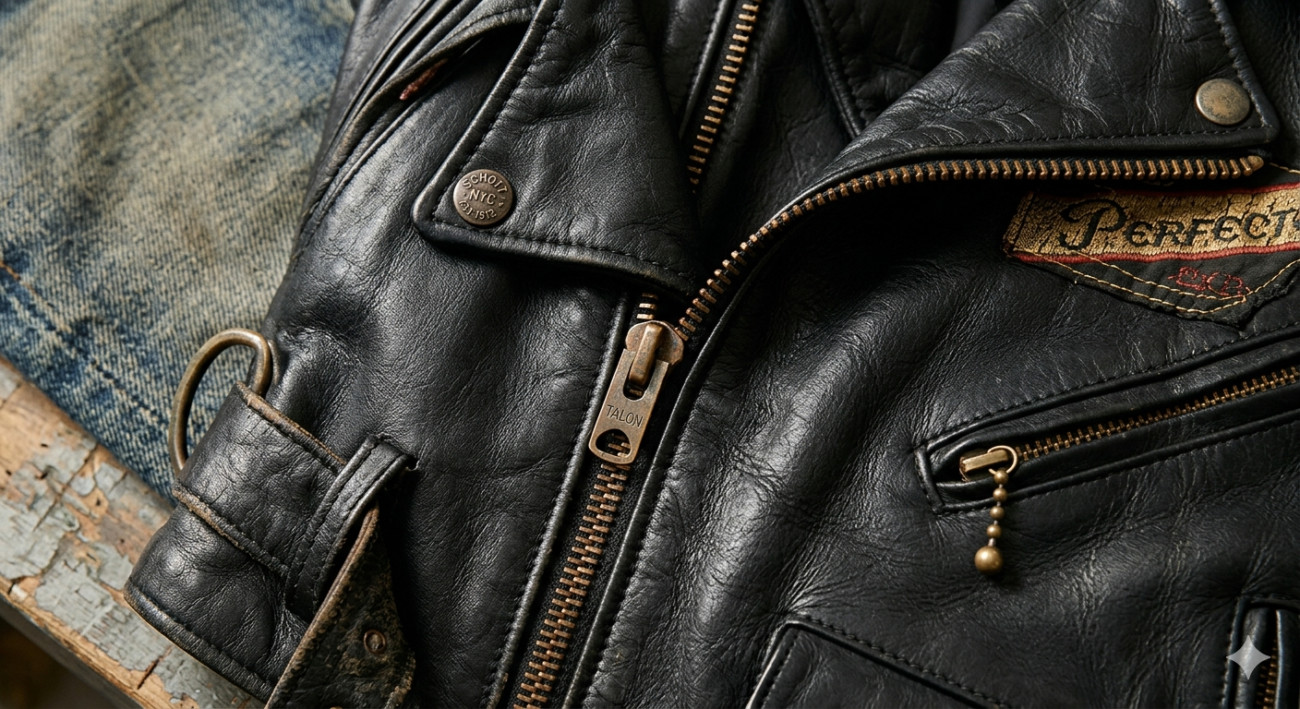
Hardware was American-made and built to last. Talon zippers, Scovill snaps, cast brass or nickel hardware — these components were sourced from domestic manufacturers who were themselves operating at peak postwar quality. The zipper teeth on a 1950s jacket will outlast almost any modern equivalent. They were designed for repeated use by people who needed their gear to function reliably.
Construction was labor-intensive. Panel counts were often higher, stitching was denser, and the internal structure — quilted linings, interior pockets, storm flaps — was built with real care. These jackets were expensive relative to average wages, sold to buyers who expected them to last a working lifetime.
—
The 1970s: Style Takes the Wheel
By the early 1970s, the motorcycle jacket had undergone a cultural transformation that directly impacted its physical construction. The postwar rider identity had evolved. Rock and roll, counterculture, the Perfecto as fashion icon — the people buying moto jackets in 1972 were a much more diverse group than the riders of 1955, and many of them were buying primarily for the look.
Manufacturers responded rationally: they built to the market they were actually selling to.
Leather standards loosened. Horsehide had largely disappeared from mainstream production by the early 1970s. Cowhide became standard, and the cowhide used in this era was generally lighter and softer than its 1950s equivalent — more comfortable at purchase, faster to wear in, more accessible in feel. For buyers who weren’t going to put 10,000 miles on the jacket, this was fine. For long-term durability and patina development, it’s a meaningful step down.
Split leather and lower-grade hides started appearing in some production runs, particularly from brands expanding into mass market distribution. The difference is visible and tactile — these pieces feel and look thinner, and they’ve aged less gracefully over the decades since.
Hardware shifted toward cost efficiency. The Talon zippers that defined 1950s jackets gave way in many cases to imported alternatives of varying quality. The snaps and buckles became lighter, the cast hardware more stamped. Functional? Often yes. The same quality? Rarely.
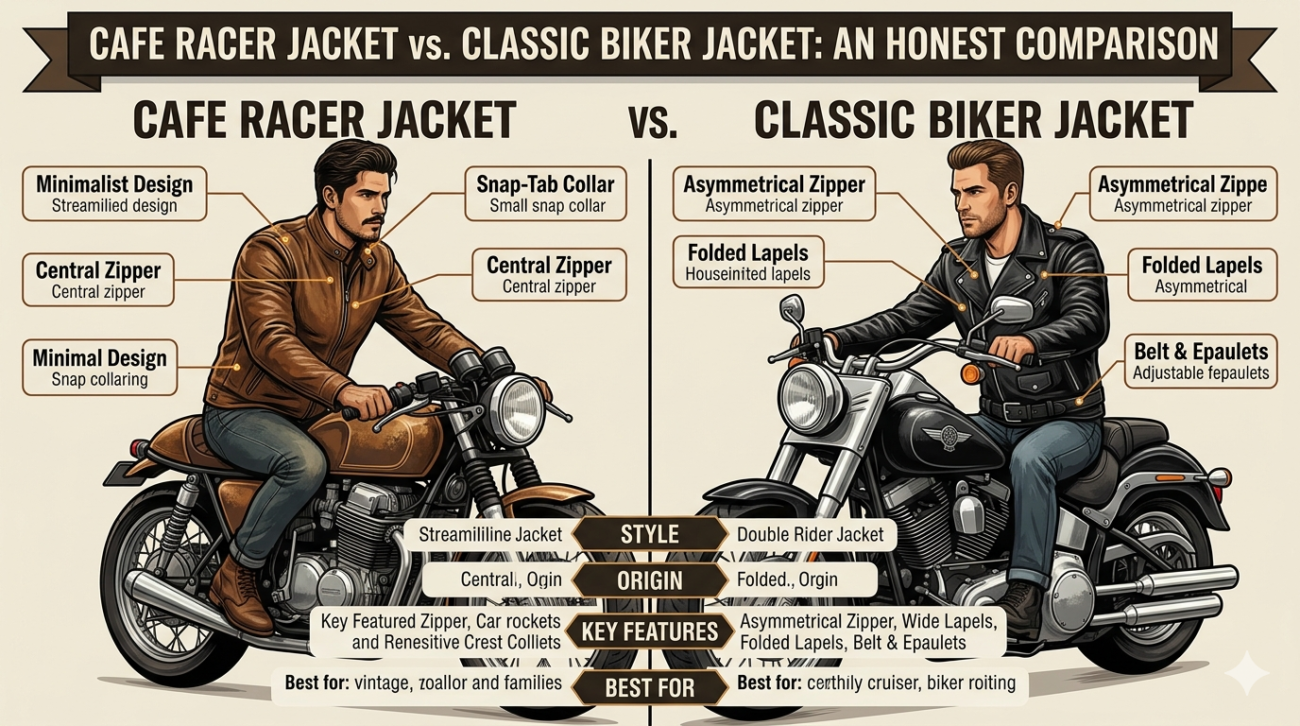
Silhouettes changed. The moto jacket vintage decade shift in the 1970s also reflects changing body ideal aesthetics. 1970s cuts tend to run longer in the body, with slightly less aggressive shoulder structure. The waist suppression that gives 1950s jackets their compact, rider-forward stance became less pronounced. Some collectors prefer the 1970s silhouette for everyday wear — it’s more relaxed, less deliberately challenging.
—
Where Each Era Wins
This isn’t a straightforward “1950s good, 1970s bad” argument. The picture is more interesting than that.
The 1950s wins on: raw material quality, hardware integrity, long-term patina potential, collector value, and investment thesis. If you’re buying with an eye toward appreciation, original 1950s pieces — particularly confirmed horsehide construction — are in a different league.
The 1970s wins on: wearability straight off the rack, availability (more pieces survived into the present market), relative affordability, and in many cases, a slightly more modern silhouette that integrates more naturally with contemporary wardrobes. A well-preserved 1970s cowhide jacket makes an excellent everyday wear.
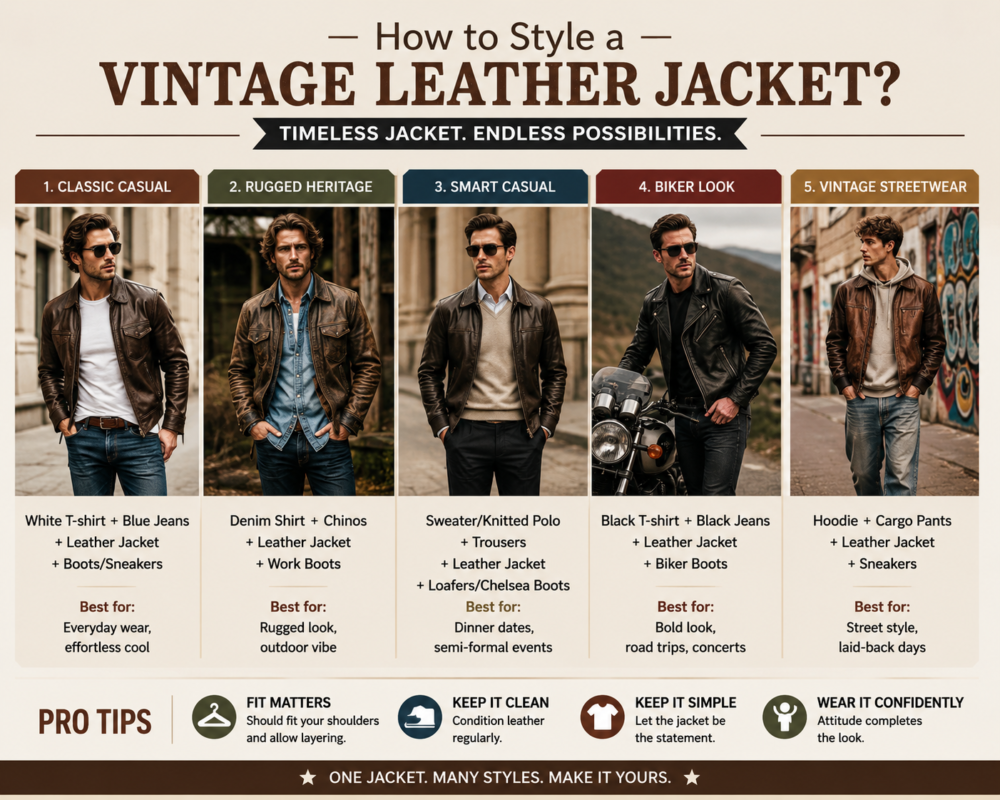
You can explore vintage leather jackets across different era aesthetics to understand how the design language evolved — the visual grammar is related even when the construction differs significantly.
—
How to Actually Tell Them Apart
When you’re evaluating a jacket in person or from photos, here’s what to look for:
Check the zipper. Talon zippers — look for the brand name stamped on the pull — are almost exclusively a 1950s and early 1960s indicator. If the zipper is Talon, you’re almost certainly looking at a pre-1965 piece.
Feel the leather. This takes some experience, but 1950s horsehide has a specific density and texture that differs from cowhide. It feels almost board-like when cold, and has a very tight grain pattern. 1970s cowhide tends to feel more immediately supple.
Look at the hardware construction. Cast and solid metal hardware versus stamped lightweight alternatives. Weight the zipper pull in your hand. Serious mass in the hardware points earlier.
Examine the lining. 1950s linings are often quilted and structured — functional insulation for actual riders. 1970s linings frequently simplified toward lightweight acetate or nylon, reflecting the shift away from functional riding use.
Consider the silhouette. Shorter, more compact body with aggressive waist suppression points toward the 1950s. Longer body with a more relaxed stance is a 1970s indicator.
If you’re ready to start [shopping men’s moto leather jackets](/shop/mens-moto), understanding these differences positions you to evaluate pieces accurately rather than taking a seller’s word for dating.
—
The Informed Buyer’s Advantage
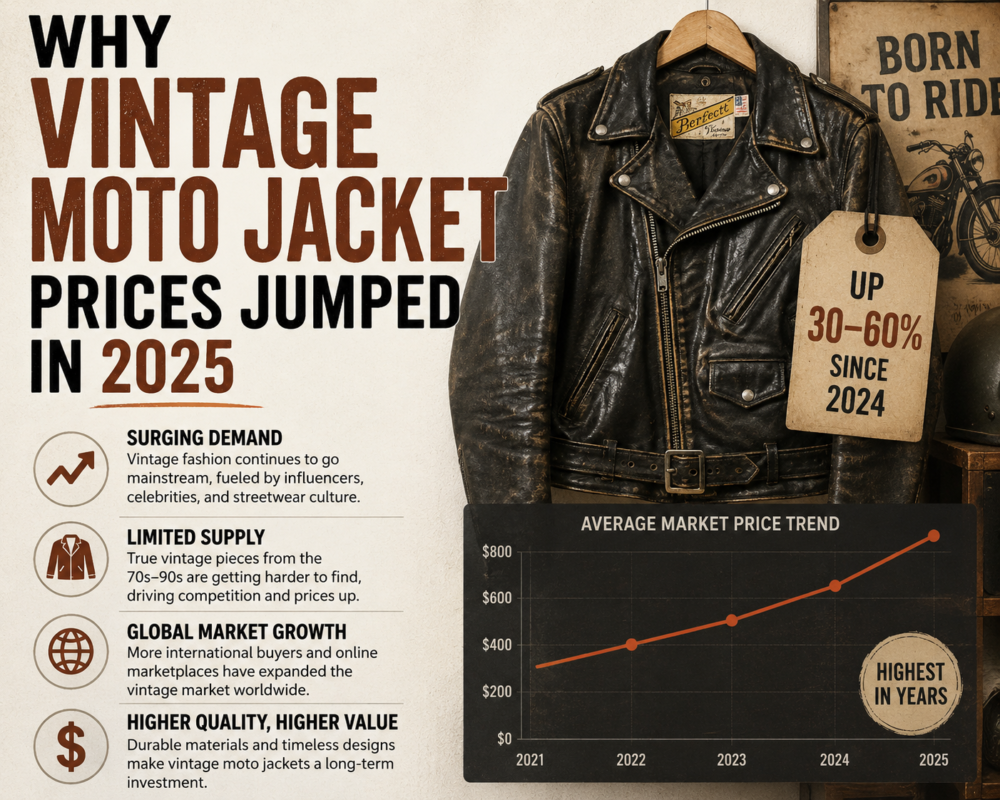
The Outer Edition’s vintage leather jacket market rewards knowledge more than almost any other category of vintage clothing. The price gap between a confirmed, correctly dated 1950s piece and a misattributed 1970s jacket presented as older can be $400–$600 or more. Sellers who know their inventory will price correctly. Sellers who don’t — or who are deliberately obscuring — won’t.
Come to every purchase with this framework in hand. The difference between the decades isn’t subtle once you know what to look for. [Shop by style](/shop) with the era lens active, and you’ll move through the market with a confidence that most buyers simply don’t have.